
Education
NOUN To Adopt NECO’s e-Verify Platform From 2026 Admission Cycle

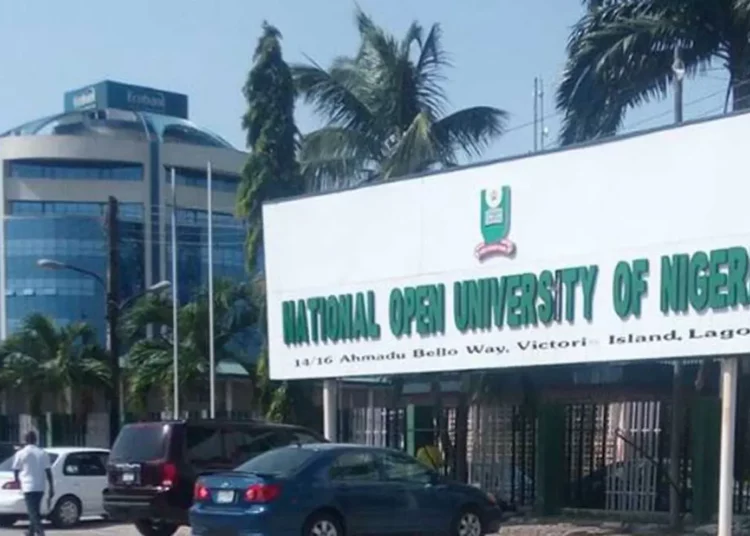
Registrar of the National Examinations Council (NECO), Prof. Ibrahim Dantani Wushishi, has announced plans to deepen collaboration with the National Open University of Nigeria (NOUN) to enhance the verification of candidates’ results and promote computer-based examinations nationwide.
Speaking during a visit to the university yesterday, Wushishi said the partnership is aimed at safeguarding the integrity of NECO certificates and ensuring that only candidates with authentic results gain admission into NOUN.
Wushishi said the visit was driven by three key objectives: to formally felicitate with the new VC, to explore collaboration on result authentication through NECO’s e-Verify platform and to examine areas of cooperation in computer-based testing (CBT).
While providing further details, the NECO boss recalled that the organisation previously handled result verification manually, often taking months to process requests from institutions in more than 50 countries.
“With the API integration, institutions can seamlessly confirm the authenticity of candidates’ NECO results without delay,” Wushishi said, urging NOUN to key into the platform.
Responding, Prof. Uduma welcomed the initiative and assured NECO of the university’s readiness to collaborate.
He stressed that result verification is critical to maintaining academic integrity. “Any certificate that is not verified is a paper tiger.”
Uduma disclosed that the university would begin integration with the NECO e-Verify platform from the 2026 admission cycle.
He also affirmed NOUN’s willingness to support NECO’s CBT expansion, citing the university’s network of about 128 study centres in the country.
To fast-track implementation, the vice-chancellor announced the constitution of a joint committee comprising key academic and ICT officials to interface with NECO.
-Leadership
Education
NFVCB Boss Urges Stronger Distribution Channels As Coal City Film Festival 2026 Opens In Enugu

The Executive Director/Chief Executive Officer of the National Film and Video Censors Board (NFVCB), Dr Shaibu Husseini, has called for stronger distribution frameworks within Nigeria’s film industry to ensure that locally produced content achieves global visibility.
Dr Husseini made this call while delivering the keynote address at the opening ceremony of the 2026 edition of the Coal City Film Festival, held in Enugu.
Welcoming participants to the festival, Dr Husseini expressed his personal delight at hosting the event in Enugu, his birth state, noting the city’s rich cultural heritage and longstanding contributions to Nigeria’s creative landscape.
He commended the festival organisers, particularly the Festival Director, Uche Agbo, for their resilience and commitment in sustaining the initiative.
According to him, the Coal City Film Festival has grown into a significant cultural platform and a must-attend cinematic event in South East Nigeria.
Speaking on the festival’s theme, “Local Stories, Global Screens,” Dr Husseini emphasised the importance of authenticity in storytelling. He noted that films rooted in local realities, languages, and cultural truths often resonate more strongly with global audiences.
He cited notable Nigerian productions such as “King of Boys” by Kemi Adetiba, “The Wedding Party” by Mo Abudu, “Anikulapo” by Kunle Afolayan, “Black Book” by Editi Effiong, and “Lionheart” by Genevieve Nnaji as examples of culturally grounded stories that have gained international recognition on platforms such as Netflix and at global film festivals.
While acknowledging the growth in film production across Nigeria, the NFVCB boss identified distribution as a major bottleneck in the industry. He observed that many high-quality films struggle to reach audiences both locally and internationally due to limited distribution channels.
Dr. Husseini therefore urged film festivals across the country to evolve beyond networking platforms into active marketplaces where filmmakers can secure distribution deals. He stressed that festivals must attract distributors, exhibitors, streaming platforms, and marketers to create tangible opportunities for filmmakers.
“Film festivals must become gateways to distribution where filmmakers leave not just with applause, but with real opportunities,” he said.
Reaffirming the Board’s commitment to industry development, Dr. Husseini stated that the NFVCB has continued to reposition itself as a partner in progress by engaging stakeholders, improving classification processes, and promoting a balance between creative freedom and social responsibility.
However, he raised concerns over increasing non-compliance with regulatory requirements, noting that some filmmakers bypass the Board by releasing unclassified films or operating without proper licensing.
He reiterated that all films and video works must be submitted to the NFVCB for classification and registration before being released on any platform, including digital platforms such as YouTube.
“This is a legal obligation, and the Board will not hesitate to take decisive action against defaulters,” he warned, adding that regulation is essential for protecting the industry, audiences, and national values.
Looking ahead, Dr. Husseini assured stakeholders of the Board’s continued collaboration with filmmakers and festival organisers to build a structured, sustainable, and globally competitive Nigerian film industry.
He concluded by commending the organisers of the Coal City Film Festival for their vision and contribution to Nigeria’s cultural economy, urging filmmakers to continue telling authentic stories that can resonate across global screens.
-Leadership

The Academic Staff Union of Universities (ASUU) has issued a four-day ultimatum to the Federal Government, demanding the immediate implementation of a newly approved salary structure for university lecturers nationwide.
ASUU President, Christopher Piwuna, made this known on Thursday while delivering a speech at a public lecture held at Sa’adu Zungur University, Yuli Campus, in Bauchi.
“We have issued a four-day ultimatum from today to the Federal Government to begin the payment of the newly approved salary structure. Failure to comply will attract a strong response from the union,” he said.
The ASUU president noted that the demand forms part of broader efforts to improve the welfare of university lecturers and address long-standing concerns about poor remuneration, which he said has contributed to brain drain and declining standards in Nigeria’s higher education sector.
Analysts at Afrinvest West Africa have warned that Nigeria’s inflation trajectory may reverse its recent disinflation trend, with headline inflation projected to climb to about 16 per cent in the near term, driven by the ripple effects of the escalating Middle East crisis on energy and domestic prices.
This is as they stressed that without swift policy responses, rising energy costs could deepen cost-of-living pressures and erode recent gains in price stability.
However, the analysts noted that the decline was weaker than expected, largely due to a resurgence in food inflation, which rose by 3.2 percentage points year-on-year to 12.1 per cent, offsetting gains in core inflation, which declined by 1.8 percentage points to 15.9 per cent.
On a month-on-month basis, inflationary pressures showed renewed volatility, with headline inflation rising by 2.0 per cent in February, a sharp reversal from the deflationary reading of negative 2.9 per cent recorded in January.
Despite this, analysts cautioned that underlying price pressures remain elevated, particularly from persistently high food costs and structural bottlenecks across the economy.
Looking ahead, Afrinvest highlighted that developments in the Middle East pose significant upside risks to inflation. According to the firm, crude oil prices have surged to about $105 per barrel from $72.69 at the end of February, triggering a sharp increase in domestic energy costs.
The report noted that the spike has already translated into higher retail prices of petroleum products, with petrol rising to about N1,350 per litre, diesel to N1,650 per litre, and cooking gas to N1,400 per kilogram in several states.
“These increases are expected to cascade across transportation, logistics, healthcare and food prices,” the analysts said, adding that existing structural challenges such as inadequate power supply, poor road infrastructure and insecurity could further amplify inflationary pressures.
In its baseline scenario, Afrinvest projected that the pass-through effect of the energy shock could drive headline inflation up by about 150 basis points to 16.6 per cent year-on-year, while month-on-month inflation could spike to 5.2 per cent.
The firm warned that a prolonged crisis could derail the Federal Government’s target of reducing average inflation to 16.5 per cent in 2026 from 23.3 per cent recorded in 2025.
To mitigate the impact on households, Afrinvest urged the government to implement targeted interventions, including the rollout of affordable mass transit systems, healthcare subsidies for low-income earners, and the temporary suspension of tariffs and related charges on food imports and other essential commodities.
-Leadership

NFVCB Boss Urges Stronger Distribution Channels As Coal City Film Festival 2026 Opens In Enugu

Wike Reaffirms Nigeria–EU Ties, Moves To Reclaim Encroached Diplomatic Lands

Inspector-General Disu Submits 75-Page Framework On ‘State Police’ To Senate As Push Gains Momentum

5 Life Lessons from Manchester City EPL Current woes

Liverpool Announce Jürgen Klopp Return To The Club

MTN Teams Up With Meta To Boost WhatsApp Call Quality


-
 Health12 months ago
5 Life Lessons from Manchester City EPL Current woes
-
 Sports12 months ago
Liverpool Announce Jürgen Klopp Return To The Club
-
 Business12 months ago
MTN Teams Up With Meta To Boost WhatsApp Call Quality
-

 News12 months ago
Commonwealth Observers Prepare For Gabon Presidential Election
-

 Health12 months ago
Ponzi Scheme CEO Francis Uju Udoms of Addfx Case still Unresolved Despite SEC certification
-

 News12 months ago
Chibok Girls: 11 Years Of Anguish, Broken Promises
-

 News12 months ago
Wike’s Enviable Road Construction Method along Nyanya- Maraba Highway
-

 News9 months ago
NASRE Promises Support To Daily Times Group Business Editor, Oseni, Over Serious Road Accident